Dog Diversity
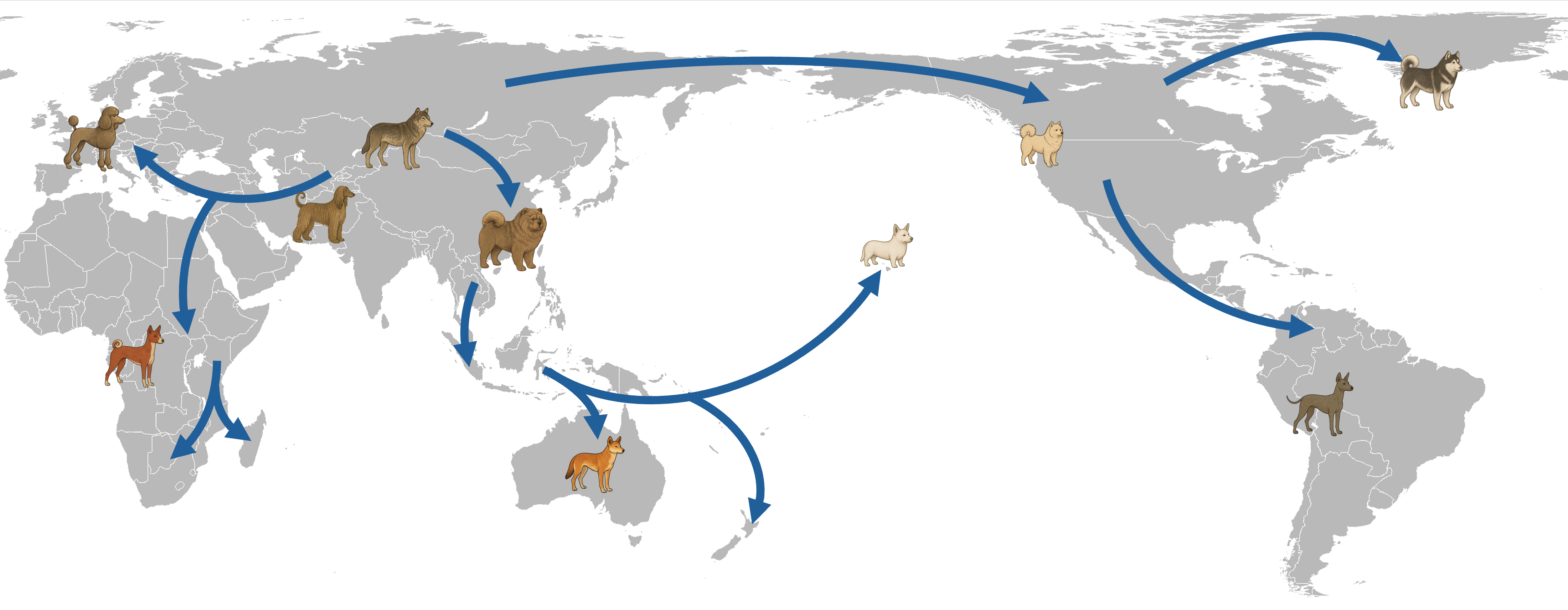
Dogs were domesticated from gray wolves in the Late Pleistocene in Eurasia. They subsequently expanded to societies all around the world, from the tropics to the arctic, to societies of foragers, pastoralists, and agriculturalists. They took on roles as companions, watchdogs, hunters, herders, and sled-haulers, among other roles. I am deeply fascinated with how dogs have adapted to such a diverse range of circumstances. Previous research has found that dogs and humans convergently evolved adaptations to high altitude and to digesting starches and lactose. Dogs have evolved traits and abilities that help them at jobs such as hunting, herding, and hauling. There is evidence that dogs have evolved temperaments and communicative abilities that help them live among humans. Surely there are even more adaptations of dogs waiting to be discovered. I argue that the field of anthropology can benefit in a variety of ways from the study of dogs around the world and across time. As part of a collaborative team, I helped study how dogs' gut microbiomes vary across different environments all around the world. I am currently developing collaborations to study Carolina Dogs, an interesting variety of dog that was found free-living in the swamps of South Carolina. I plan to continue studying the ways in which dogs have adapted to the diverse physical, environmental, and social conditions they are found in.
- Gautam, A., Bhandari, D., Gurung, K., Gyawali, A., Gurung, K. Yadav, P., Smith, K.C.M., Ahmad, A.R., Shrestha, D., Ange-van Heugten, K., Weyrich, L., Karna, A.K., Jha, A.R. Industrialization restructures the domestic dog gut microbiome while preserving host specificity. mSystems. In press. Preprint on bioRxiv.
- Smith, K.C.M. Why anthropologists should study dogs. Evolutionary Anthropology. 2026.
Publications
- Aashish Jha
- Arya Gautam
- Laura Weyrich
- PJ Perry
- Carolina Dog Fanciers of America
- I. Lehr Brisbin
- Donna Brisbin
- Jennifer Farrior