Publications
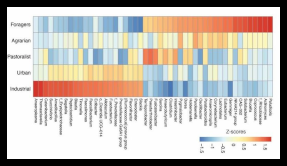
Industrialization restructures the domestic dog gut microbiome while preserving host specificity (mSystems, in press)
Arya Gautam, Dinesh Bhandari, Kusha Gurung, Aashish Gyawali, Kshitiz Gurung, Pratiksha Yadav, Kyle C.M. Smith, Anique R. Ahmad, Deena Shrestha, Kimberly Ange-van Heugten, Laura Weyrich, Ajit K. Karna, Aashish R. Jha
Dog gut microbiomes vary across different living environments, especially between industrialized settings compared to foraging and pastoralist societies.
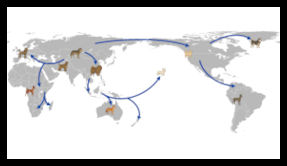
Why anthropologists should study dogs (Evolutionary Anthropology, in press)
Kyle C.M. Smith
The study of dogs has wide-ranging applications from in biological anthropology, cultural anthropology, and archeology.

The Cognitive and Stress-Related Roots of Dog Domestication: A Behavioral Physiological, and Microbial Framework (Doctoral Dissertation, 2025)
Kyle C.M. Smith
Doctoral dissertation for the Pennsylvania State University Department of Anthropology.
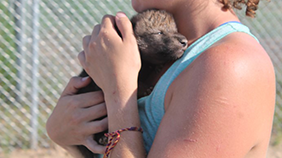
Response to Hansen Wheat et al.: Additional analysis further supports the early emergence of cooperative communication in dogs compared to wolves raised with more human exposure (Learning & Behavior, 2023)
Hannah Salomons, Kyle C.M. Smith, Megan Callahan-Beckel, Margaret Callahan, Kerinne Levy, Brenda S. Kennedy, Emily Bray, Gitanjali E. Gnanadesikan, Daniel J. Horschler, Margaret Gruen, Jingzhi Tan, Philip White, Bridgett M. vonHoldt, Evan MacLean, and Brian Hare
Further analysis supports the early emergence of cooperative communication in dogs compared to wolves.
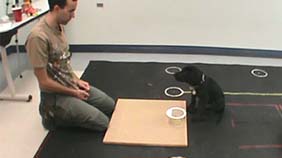
Cooperative communication with humans evolved to emerge early in dogs (Current Biology, 2021)
Hannah Salomons, Kyle C.M. Smith, Megan Callahan-Beckel, Margaret Callahan, Kerinne Levy, Brenda S. Kennedy, Emily Bray, Gitanjali E. Gnanadesikan, Daniel J. Horschler, Margaret Gruen, Jingzhi Tan, Philip White, Bridgett M. vonHoldt, Evan MacLean, and Brian Hare
Domestication altered dogs’ developmental pathways to enhance their cooperative communication with humans.